
Ray Russell's Spiritual Forecast
Written by Ben Cox with Ray Russell
From the Archives: The Journey Summer 2015
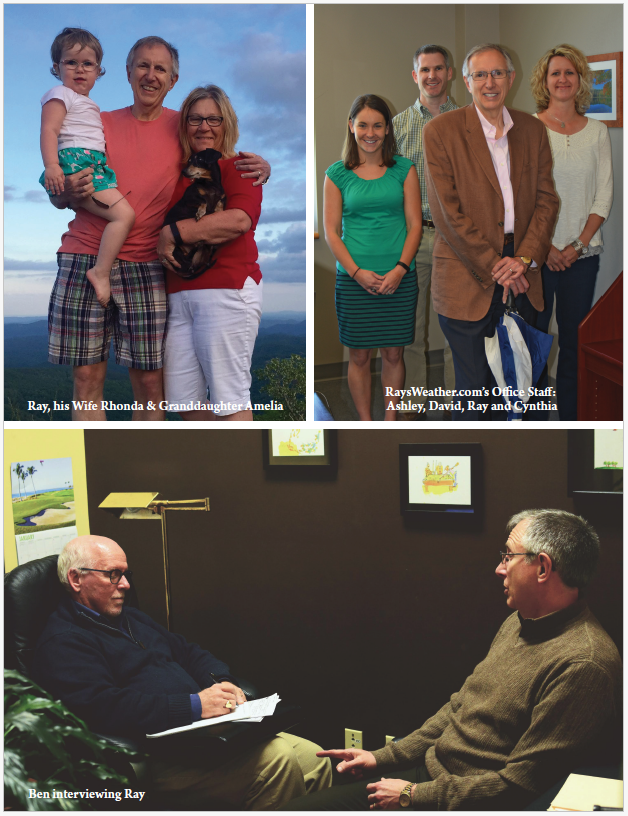

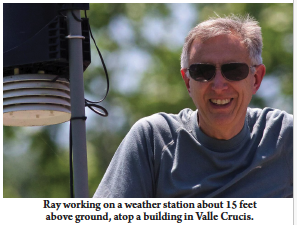
Many people across the mountains and foothills of Northwest North Carolina are familiar with Ray’sWeather.com because it’s where hundreds of thousands of us turn to get our weather forecasts with the most “local” flavor. And, if you’re one of those who goes to Ray’s Weather site to get your weather information, you probably know that what began as a hobby for Ray Russell, a computer science professor at Appalachian State University since 1991, has morphed into a very successful business that covers the weather across our region with 60 weather stations in all and 10 employees.
But, what you don’t know is that Ray’s 35 year career as a computer science professor was almost set aside when he came home from college in his freshman year and announced to his parents that he was switching his major from computer science to Bible.
It was 1975 when Ray made the decision to attend Freed-Hardeman University in Henderson, Tennessee, with the idea of majoring in computer science. Several things influenced him to choose this path.
The school, at that time, was affiliated with the Church of Christ, which had played a significant and meaningful role in Ray’s family. His dad was an educator in Middle Tennessee as a school teacher and principal, but he also was the minister at the local Church of Christ where Ray was raised. When Ray was considering where he would attend college, he had an interest in computer science because he was good at math and he knew his employment prospects would be good with a degree in an up and coming field like that. Since Freed-Hardeman was one of the few schools that offered a degree in computer science, that’s where Ray landed.
Every student at Ray’s new school was required to take a class in Bible and also attend daily chapel services. The class that influenced Ray to want to change his major was entitled: “Life of Christ: A Study of the Gospels,” and it was taught by a renowned Church of Christ leader named Rubel Shelly. After being so impressed and so convinced by the things he was learning there, Ray came home from college one weekend and made this announcement: “Mom, Dad, I’m not going to major in computer science anymore, I’m going to major in Bible!” Rather than disagree about this, his parents made this wise suggestion: “Son, since we’re paying for your education we’d like for you to stay with your major, but maybe you could do both.” “That’s when I became the only person in history to have a double major in Bible and Computer Science,” Ray said.
Majoring in Bible and then being very involved in leadership roles in the Church over the last 35 years is a major part of Ray’s life that only those closest to him know about. However, it’s one he’s happy to reveal, because it’s foundational to everything else he does, including Ray’sWeather.com. As we continue with this story, most of it will be told exactly as he told it to this writer. However, I must admit that I have embellished it a bit, but I’ve done so with Ray’s complete approval and collaboration.
“I’ve never wanted to be overt about my faith through the weather site that I started, because that’s not what it’s about. It’s about getting a professional, accurate, local forecast of the weather. But, I have wanted the site to be a wholesome, positive experience for people to start their day with, and I think we’ve succeeded in doing that. And now I’m happy to be able to share about the importance of my faith through this publication. I say this because I want people to know things about me beyond the website, and beyond my career as a computer science professor.” So, now we get to hear the rest of Ray’s story about his life as an elder, deacon, minister, song director, wedding singer and guest Sunday School teacher here in the High Country. As this story unfolds and as the reader considers his insightful comments about the state of Christianity in our nation, I believe you’ll pick up on some spiritual forecasting that’s important to heed.
“There was a church in Luray, Tennessee called Luray Church of Christ. It was about 30 minutes from Freed-Hardeman, and they had a tradition of reaching out to the University for Student Interns to speak at their Sunday meetings. During my sophomore year, another student and I were recruited to do that, and it was a wonderful experience for me. They were a sweet, forgiving, forbearing group of folks who lovingly tolerated these greenhorns learning how to teach the Bible.

One of the most wonderfully influential parts of that experience was a simple piece of paper that was taped to the pulpit with this short verse taken straight from the gospels. It said, “Sir, we would see Jesus.” That was a great reminder for us young buckaroos to remember when we stood to teach, because it’s not supposed to be about us, but about Jesus. Little did I know what that stint as a student intern would lead to in regard to future opportunities to speak at many churches, and even minister at a few.
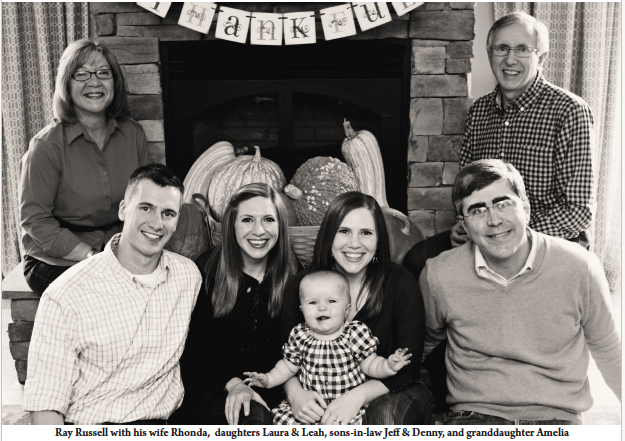
As a result of being well received as a student intern speaker at the Luray Church of Christ, other speaking opportunities opened up for me. Before long I was speaking at churches all over the Southeast as an ambassador for Christ and my school. This led to an unusual call to be the minister of a Church in Mississippi right after I graduated from college in 1979. With great enthusiasm and anticipation I accepted this position because I was excited about the opportunity to get paid to preach and to be entrusted with the opportunity lead a church. Now, before I continue with this story, let me tell you about how I met and married my wonderful wife Rhonda, because she is my much better half and she figures prominently into this story of my first ministry.
Rhonda and I met in college as a part of a choral group that would sing in Churches of Christ across the country. Well, it just so happens that Rhonda’s dad was a minister just like mine was, and he invited our choral group to sing in Galax, Virginia. It was common for us to stay in the homes of church members when we traveled to do events like this and guess where I got to stay… You guessed it. I was one of the people who Rhonda picked to stay at her parent’s house, and that’s where the romance that would lead to our marriage began.
We were married in 1978 between my junior and senior year, so when I got this call to move to Mississippi to minister, Rhonda moved with me and got a job teaching second grade in the public school. That’s where we both experienced major culture shock, because some white people in this little town were racist, and a few people in the church I was called to were racist, too. On top of this, the poverty level and the gap between the rich and poor of the town was something my wife and I had not encountered before. Though there weren’t any signs that designated a separation for where white people were allowed, and where black people were allowed, it was certainly implied. For example when we first went to the doctor’s office in town, there was a clear established understanding of where the different races were to sit. Then, we were more astounded to discover that this same doctor had spearheaded an effort to establish a white private school to counteract public school integration. As a result, my wife’s second grade class of 34 children only had two white children.
Being thrown into a culture with this kind of poverty and racism was one thing, but when we encountered racism among church people, who I naively assumed should know better, it was hard for us. Our parents and the churches we were raised in had raised us to understand from the Scriptures that prejudice of any kind was wrong. Yet, here in the Deep South, the culture had obviously influenced the Church more than the Church had influenced the culture.
This is where I became grateful for what I had learned from some of my Bible professors at Freed-Hardeman University. They had taught me to teach through different books of the Bible instead of only teaching topically. The logic was that when you come to the truth in the Bible that might confront things in people’s lives that need to be confronted, the minister can’t be accused of picking on anybody. So, when I decided to preach through the book of James, I did so knowing that people would be challenged to confront their prejudicial attitudes if they had them. I say that because this book of the Bible confronts prejudice in a powerful way. The good news is that there were many wonderful people in that church who already knew that the kind of racism that existed in our town was wrong. Also, there were many who were willing to accept the truth and change their views. The bad news is that not all of the church was receptive to what the Scriptures have to say about unconditional love of our fellow man.
Though this was a hard experience for us, it was a good one. Because we had both been raised in solid homes and churches, we had an idealistic, rose-colored perception of things. This time in Mississippi gave us a dose of reality that has served us well from then until now. We have both remained deeply committed to our faith, yet understanding that there are times when people who consider themselves Christians need to be willing to change their beliefs or their attitudes as the Holy Spirit moves to give us a deeper understanding of the truth of the Scriptures. This is particularly true when we’ve held presuppositions that make us come off as judgmental know it alls instead of loving, humble, faithful servants of Christ.””
This is the point in Ray’s story where his Computer Science major comes back into play. This is important to the overall story because it will help us understand how he’s evolved to be the Ray we know through his website and as a university professor. However, we are going to come back to his parallel life as a minister.
Right on the heels of Ray’s culture shock experience in Mississippi, he was offered a position at his alma mater as a computer science professor. This offer also came with an agreement that he could pursue his master’s degree while he was on staff there. That opportunity led to Ray being a master’s degree student at the University of Memphis, which led to him pursuing his PhD at Georgia Tech. What astounds me about this part of Ray’s story is that while he was still in his early twenties, he had already had two careers, and he was about to become Dr. Ray Russell and launch a long successful career in the academic world, while still maintaining a strong leadership role in the Church of Christ. With that in mind, let’s pick up Ray’s story in Atlanta, Georgia, where he was getting his PhD, and where he had also been asked to do some supply preaching at the Druid Hills Church of Christ right in the heart of downtown Atlanta.

“Little did I know that this six month supply job would turn into two and a half years as the interim minister there. The whole time I was in grad school, I was also at this church in a part of Atlanta that’s been revitalized now, but was pretty rough then. Right next door to our church building there was a halfway house for patients who had been released from mental institutions, and we often had visitors to our services from the residents there. This made for some interesting services, and seemed to highlight to me the difference our church could make right where we were. Yet, in spite of efforts from the church eldership to encourage outreach to our community, it didn’t happen. They were trying to inspire our fellow church members to realize the opportunity we had to begin the type of urban ministry that could have a positive impact on the community. The idea was to help our members understand that church was meant to be so much more than just coming together to sing a few hymns and hear a nice Bible teaching. We were trying to emphasize that Christianity was never meant to be only about being a part of a religious club and receiving God’s blessings. Yes, God wants to bless us, but He blesses us to be a blessing. Well, long story short, the church resisted that message. The church doors closed and the property was sold.”
As Ray continued to talk about his own experiences in his church, and as he made observations about all churches of the Christian faith, he candidly shared some concerns that all believers from all denominations would be wise to hear. He talked about some bright spots and some good things that he sees happening within Churches of Christ and in the church at large, but he also said this: “I am having a crisis, but it’s not a crisis of my personal faith in Christ, it’s a crisis of faith in current practices of many churches.”
Recently, a widely read Pew Research study highlighted the sharp decline in church membership for people between the ages of 20 and 40, and a significant drop in membership among most churches. I am totally unsatisfied with the explanation offered by most church leaders, that millennials are disinterested in spiritual matters, or that our culture has lost its desire for God, etc. Instead I believe that it is church leadership that has lost its way. We have fought the wrong battles (over church “trivia” and symbols instead of justice, mercy, and righteousness). We have turned inward, building higher and thicker walls between “us” and “them”. We have become known for being angry and judgmental instead of caring, understanding, and loving. In some circles, we have become “anti-intellectual,” forcing people to choose between science and a poorly informed view of God’s work in this world. And we have put too much emphasis on “being in church” rather than God’s mission in the world. It is past time for us to rekindle the spirit of Israel’s prophets…
“He has shown you, O mortal, what is good. And what does the Lord require of you? To act justly and to love mercy and to walk humbly with your God.”
-Micah 6:8
As I end this story about Ray Russell’s spiritual journey, it’s clear that he’s so much more than just a professor and a weather forecaster; he’s doing some spiritual forecasting that we need to tune into as well.