
It Is Well
By Benjamin Cox, Ben’s Son
It was around 4:30pm, when the nurses at the Wake Forest Baptist Medical Center called us to my father’s room to say goodbye and be together, a final time, as a whole family.
We filed down the hallway, my mother and each of us six kids, each cradling our internal crisis and striving to hold it together. Pale fluorescent lights illuminated the hallway toward the ICU door, while muted natural light drifted through the courtyard windows, offering a quiet softness against the harshness of the moment. The nurses had us wait outside while they removed his ventilator. The doctor informed us it could be minutes, hours, or even days before he passed. Finally, they invited us into the room.
Dad was seated upright on the hospital bed, unconscious and breathing peacefully - a welcomed juxtaposition to the jerky nature of the ventilator he’d been on for days. My sisters put together a playlist of his favorite worship songs and hymns, which lilted softly on a phone by his left ear.
My brother-in-law, a minister, joined us, briefly, for an invocation. He started with Psalm 23, and asked God to be with us, to give us strength, and receive Dad triumphantly in His grace. We gathered around our dad and watched him breathe.
We did not enter that room with a defined order of operations, no guideline or agreed-upon sequence of events; just six adult kids and their parents stuck in a tortuous circumstance, bound by a divine trust that the space we inhabited in that moment was truly sacred. Perhaps the most grounding presence in the room were the familiar songs that filled the air between us, those we grew up singing in church: “Shout to the Lord”, “Awesome God”, “The Heart of Worship”, “How Great Thou Art”, and, appropriately, “It Is Well With My Soul”.

Sustaining Worship
“It Is Well With My Soul” was my father’s favorite hymn. The hymn had followed him through decades of faith, grief, service, and loss. His father, Benjamin Wofford Cox Sr., was a Baptist minister who exhorted faithfulness in God’s divine plan throughout life’s challenges. That faith sustained both him and the troops he served as a chaplain during WWII, where he sang the song with men on death’s door.
There is no doubt my father heard the hymn as a child, growing up a Baptist pastor’s son. As an adult, Dad carried the song with him into his own ministry, where he served as pastor in the High Country for over 30 years. He carried it with him into New York City, after the 9/11 attacks, where he volunteered for months alongside Billy Graham ministries to demonstrate God’s love to a city gripped in fear and loss. The hymn was played at his mother’s funeral, his father’s funeral, his sister’s funeral, and eventually, his own.
Praise By Design
There’s something so innately human in the act of song. Perhaps as a gift unto Himself, God designed us to sing with the frogs and cicadas, the birds and the whales - a world’s chorus of joy and grief, majesty and suffering held in life’s journey.
Every culture in human history sings. Parents sing to children. Soldiers sing before battle. Seekers sing before God. When words fall short of emotional resonance, song springs forth, accessible to all. It is why, unlike many other artforms, a song can become a family heirloom, passed down generation to generation.
Christianity embeds song into its practice. Singing is not an adornment of worship - it is the very act. Faith operates within such a complex emotional landscape, and worship gives Christians a language for that complexity. Doubt can coexist with belief; where suffering spills out, peace can reside. The beauty of song is that these truths can live together, at once, within a single verse.
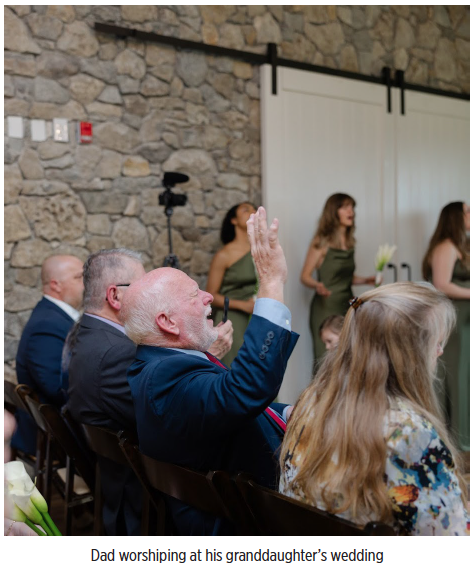
My father reveled in worship. His voice boomed through every refrain, harmonizing (always harmonizing) with the congregation, hands raised - sometimes pleading for mercy, sometimes stretching triumphantly toward the sky - each gesture its own unique prayer, a devoted and deeply personal appeal to God. He never restrained his tears, his joy, or his excitement. To fully emote in song is a peculiar freedom made possible, in part, by fellow believers inhabiting the same space and singing in unison. What a beautiful vulnerability it is to bring our whole selves - unguarded and exposed - before God and one another.
A Song Borne of Suffering
“It Is Well With My Soul” occupies a space of competing emotions with its central message of surrender, assurance, and spiritual steadiness despite tragedy. The hymn was written in 1873 by Horatio Spafford. The hymn’s message of surrender was not imagined from comfort, but conceived within catastrophic loss.
Horatio Spafford was born in Troy, New York in 1828. His family moved to Chicago during the mid- 19th century, where Spafford became a successful lawyer and real estate investor, amassing a sizable fortune. He and his wife, Anna, had five children early in their marriage. They were devoted Presbyterians and were deeply involved in charity ministries around the city. Then came trials.

In 1870, at only four years old, his eldest child died from scarlet fever. Just a year and a half later, the Great Chicago Fire engulfed the city and destroyed nearly all of Spafford’s real estate investments. In 1873, all four of his daughters died when their ship sank as they were crossing the Atlantic. Horatio chartered the next available boat, travelling the same route his family had days before. Over the very waters where his daughters drowned, riddled with grief but impelled by a divine motivation, he penned the first few lines of the poem. The words spilled onto the page:
When peace, like a river,
Attendeth my way,
When sorrows like sea billows roll;
Whatever my lot,
Thou hast taught me to say,
It is well, with my soul.
How in the midst of such unbearable loss could he summon these words - this insistence on faith when so much had been taken from him? Would he still find them three years later when his friend and the song’s composer, Philip Bliss, died in a horrific train wreck? Or four years after, when scarlet fever claimed his second son? Perhaps this song became, for him, a kind of meditation against tragedy itself, raging aloud in a blessed defiance and proclamation of his higher calling.
Though Satan should buffet,
Though trials should come,
Let this blest assurance control,
That Christ hast regarded
My helpless estate,
And hath shed His own blood for my soul.
Somewhere between the Atlantic waters, where Spafford found his inspiration, and over one hundred fifty years of trial and tragedy, surrender and hope, “It Is Well With My Soul” ceased to belong to a single man’s grief and became an anthem for the masses. It passed from one grieving heart to another; it passed through revival tents and warzones, sanctuaries and funeral homes. This is the heirloom in motion, words woven into family histories, each generation clinging to the message amidst sorrow; each generation discovering its promise anew.
My sin, oh, the bliss
Of this glorious thought!
My sin, not in part but the whole,
Is nailed to the cross,
And I bear it no more,
Praise the Lord, praise the Lord, O my soul!
Never could I have known how deeply I needed a melody until it found its way into the sterile hospital room where my father lay dying, surrounded by his wife and children. When we first entered the room, my mom told us how proud our father was of each of us. We shared stories and anecdotes, took turns holding his hand, speaking to him. But now we waited and watched his breath shorten, until, eventually, it stopped. We were physically and emotionally exhausted. Words failed us. God sent us a song.
And Lord, haste the day
When my faith shall be sight,
The clouds be rolled back as a scroll;
The trump shall resound,
And the Lord shall descend,
Even so, it is well with my soul.
Heather suggested we queue “It Is Well” to play again. She was the first to sing. Her ethereal voice cut through the moment with startling clarity as she carried the first refrain. Emily joined; then the rest of us began to sing. God’s presence settled over the room like a palpable embrace - so near, so unmistakably real, I wonder if I’ll ever experience anything like it again. Later, my mother described the moment as holy. It was, undeniably, the most holy moment of our lives.
We found the words, singing through sobs, defiant and resolute, resigned to the present. I could hear my dad’s voice so clearly singing with us. I could see him in memory, when I was a child, standing above me, tears on his cheeks, as he recited these very words.
Now those tears were my tears, my mother’s, my sisters and brothers. They flowed freely from our eyes and onto my dad’s body, now just a body, just an empty vessel for the soul that had already begun its journey home.
And we continued to sing when his chest was no longer moving.
And we continued to sing with the knowledge he was gone.
And we continue to sing despite this chasm of loss.
And we continue to sing:
It is well
With my soul,
It is well, it is well with my soul.
