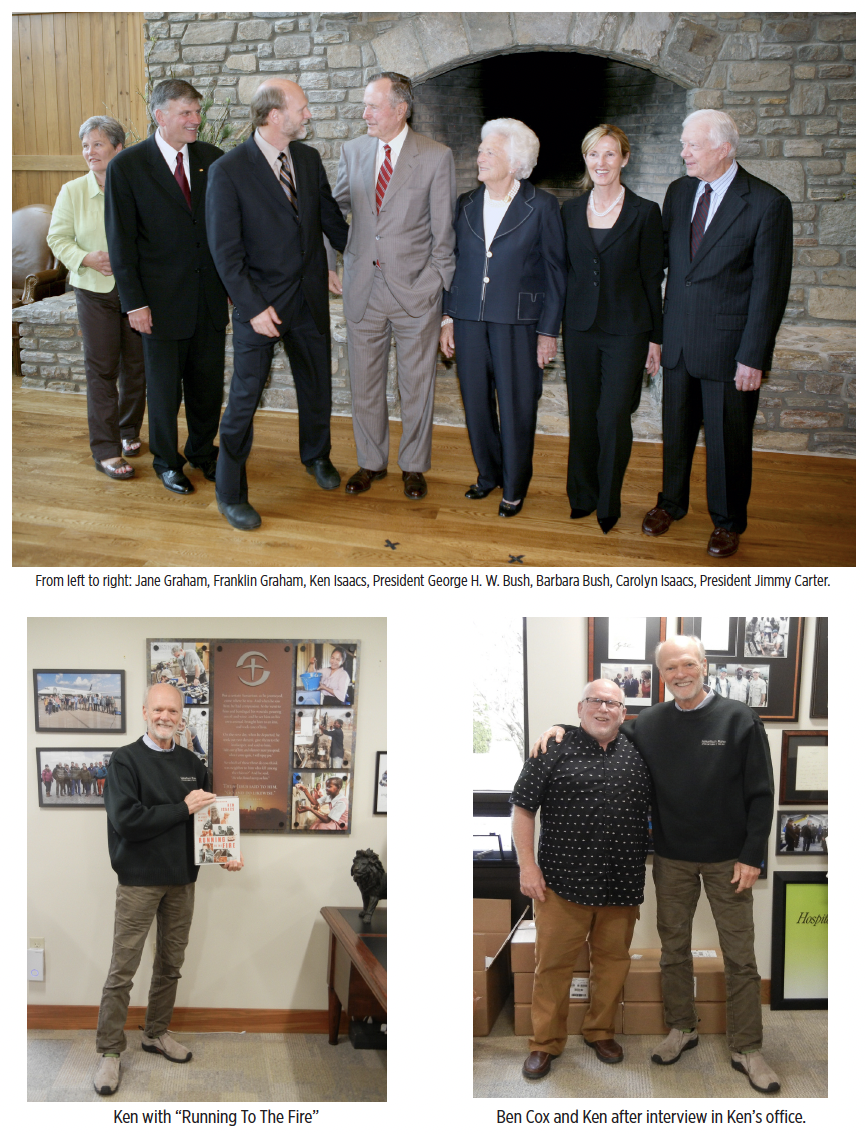
Helping in Jesus’ Name
A Personal Testimony from Ken Isaacs, Vice President of Programs and Government Relations at Samaritan’s Purse
By Ben Cox with Ken Isaacs
Introduction:
Once upon a time there was a man named Jesus who had the power to heal people. He had the power to raise people from the dead. He also could predict the immediate future with 100% accuracy. Many in Israel thought He must be the long awaited Messiah that their prophets and wise men from ancient times had foretold.
Over the span of his 3 year public ministry, He drew multitudes of people to hear Him teach truth and explain Old Testament Scripture in a way that was simple yet deeply profound. The people would even remark about how superior and powerful His speaking ability was as compared to their finest rabbis and teachers of the law.
He also made disciples by choosing 12 men to have close personal access to Him during His 3 year ministry. But, He also masterfully demonstrated the effectiveness of intentionally communicating Truth, in concentric circles of influence.
For example, among the 12 there were 3 who He invited into the most holy of intimate moments between Him and His Heavenly Father. And then there were the 70, the 120 and the crowd of 500 He appeared to after His bodily resurrection from the dead! Plus, there were thousands who traveled great distances to be healed by Him, behold His miracles and to hear Him speak the very Words of God that moved them deeply in their hearts.
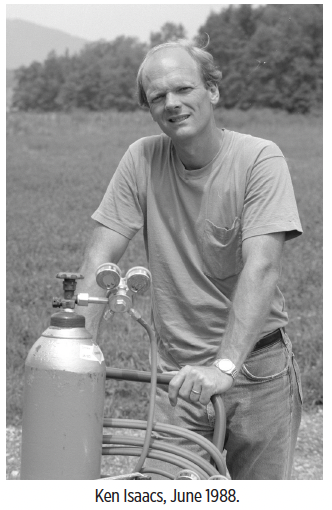

One time, after He finished one of His most challenging sermons in the outer courts of their massive, beautiful, sacred temple, in the heart of Jerusalem, His disciples asked Him this question: “what will be the sign of Your coming, and of the end of the age?”
Now’s the time we should all lean in to hear Jesus’ answer, even if you have read His answer 100s of times:
“Take heed that no one deceives you. For many will come in My name, saying, ‘I am the Christ,’ and will deceive many. And you will hear of wars and rumors of wars. See that you are not troubled; for all these things must come to pass, but the end is not yet. For nation will rise against nation, and kingdom against kingdom. And there will be famines, pestilences, and earthquakes in various places. All these are the beginning of sorrows.
“Then they will deliver you up to tribulation and kill you, and you will be hated by all nations for My name’s sake. And then many will be offended, will betray one another, and will hate one another. Then many false prophets will rise up and deceive many. And because lawlessness will abound, the love of many will grow cold. But he who endures to the end shall be saved. And this gospel of the kingdom will be preached in all the world as a witness to all the nations, and then the end will come.
I chose to begin our Kenney Isaacs’ story with a Jesus’ story from Matthew 24:3b-14, because for over 37 years Kenney has been one of the many who have made great personal sacrifices to bring the good news of the kingdom of our Lord Jesus Christ to the nations! And He’s done most of that through his affiliation with Samaritan’s Purse and the Billy Graham Evangelistic Association.
Samaritan’s Purse, with its headquarters in Watauga and Wilkes counties and the Billy Graham Evangelistic Association’s headquarters in Charlotte and Asheville, NC travels the world to communicate God’s love and compassion to a world where millions have not experienced the kind of peace, mercy and hope that only Jesus can impart!!
It was through Samaritan’s Purse disaster relief program where I first met Ken Isaacs as a volunteer where Ken had been deployed. We were in New York City in September of 2001, after the horrific terrorist bombings that shook that city and our nation.
Ken was the disaster relief responder who Franklin Graham called in to help establish a kind of disaster relief that Samaritan’s Purse had never done before. Samaritan’s Purse and the Billy Graham Evangelistic Association were going to partner together to establish an outreach office in the city. The office would be called the Billy Graham New York Prayer Center, where people could call and receive Biblical encouragement and prayer from trained professionals.
In conjunction with this, SP & the BGEA were going to join with a Calvary Church in Manhattan that would assist the Center with helping train, coordinate and deploy thousands of Christians from all over the nation to go to Ground Zero to minister the love and compassion of Jesus to the many who were suffering unbearable grief and sorrow.
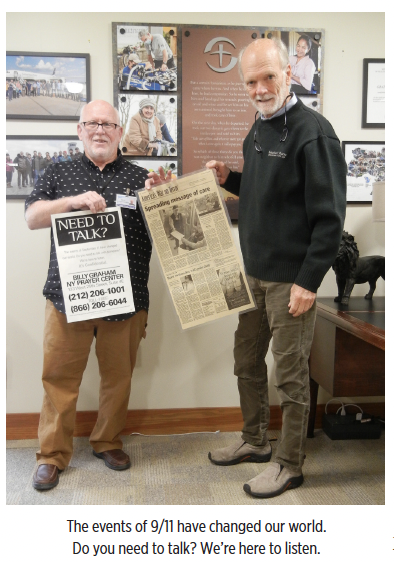

I was there as one of the first “boots on the ground” volunteer grief counselors to arrive in NYC. Allen Blume, a friend of mine, and a former pastor of Mount Vernon Baptist Church here in Boone, asked me if I would be willing to go and I said yes.
Soon after getting off that van with the other volunteers, I met Ken Isaacs, little knowing that my one week volunteer stint would turn into a “job” for the next 4 months. That happened because Ken asked me if I would agree to be the prayer coordinator for the BGEA prayer center and I said yes. Ken and I got to know each other better in the context of his work to spearhead Samaritan’s Purses efforts to get the prayer center up and running at 133 West 25th Street, Suite 4E New York City.
In the course of our time there, thousands of humble servants of Jesus came to volunteer from all over the United States of America to demonstrate our Savior’s love in practical, tangible ways.
After receiving instruction at Calvary Church on the do’s and don’ts of sharing Jesus’ love on the streets, they would reach out to Manhattan, Brooklyn, Queens, The Bronx and Staten Island to show Jesus’ love with simply ears to listen and prayers. God’s love could even come through sharing comfort over a cup of coffee in a local diner, or offering bottled water on the streets.
Meanwhile, at the call center, which Ken helped establish, we would pray with the many people who responded to the simple posters we plastered the city with and the other ways we got the message out about the help we could offer in Jesus’ name.
Through those efforts and our vast network of local churches, we partnered with, we got the word out, even joining with the spiritual leaders of local churches in the 5 boroughs to join them in praying onsite at cross-denominational prayer gatherings. In other words, we prayed, prayed and prayed some more.
One thing that the teams that came to NYC to help for a week or so were required to do was to join us at the prayer center to pray over the prayer needs we were discovering through the call center and the street ministry. As a direct result of these passionate prayers that we offered to our Father through the precious Name of Jesus, miracles happened and many received the comfort that came down from heaven. I am humbled and grateful to have been a part of that.
When I returned to Boone in December of 2001 Ken went his way and I went mine, but we would run into each other from time to time at church and other places. Now, 24 years later, I get to do one of my favorite things, which is finding out about how people like Ken became Christians and how their faith in Christ has changed the trajectory of their lives.
BEN: Tell me about how you became a follower of Christ, and then how you came to Samaritans Purse.
KEN: My mom and dad were Christians. We lived in Jacksonville, Florida, and attended Arlington Baptist Church. The pastor there was Grady Snowden, and he gave an altar call one Sunday. I was 12 years old and I felt moved and convicted by my sin and raised my hand.
The following day, he came over to the house and sat with me in the living room, and we talked through the plan of salvation, what it meant, the theology of it, and I accepted Christ that day. I was baptized maybe two weeks later. That is sort of my introduction into the faith.
As you know, all of us have different journeys in the faith. After that, there was a friend of my parents who took an interest in me, and for two years he mentored me in the Bible. That seems very unusual in today’s thinking, but he was a very special guy, and I really appreciate the time that he invested in me, his mentorship, instruction, and sharing scriptures with me. It has stuck with me all through my life, even though I went astray from the Lord when I was around 19 or 20. And by the time I was 24, I was probably an agnostic and had gotten married and wasn’t thinking anything spiritual or anything about God.
BEN: It’s sad, but there are far too many Christians, myself included, who go through a time of backsliding or fall away from faith in Christ. It’s amazing Grace that brings us back to Him in different ways for different people.
So, let’s go back to how you got from being saved in Jacksonsville, Fla. to being an agnostic married man at 24.
KEN: My parents moved all the time. In 12 years of school, I went to 13 schools in four states and seven cities until we ended up in Boone, NC. I was always the new kid in class every year, except for my last two years in high school which was Watauga High School.
It was there that I met Carolyn Wright in the beginning of my senior year and it was love at first sight. We got married two years later when neither of us was walking with the Lord.
EDITOR’S NOTE: After my in-office interview with Ken, I received permission from the book publishers to share this portion of Kenney’s testimony that Kenney wrote in his own words from pages 18-19 and it fits nicely here:
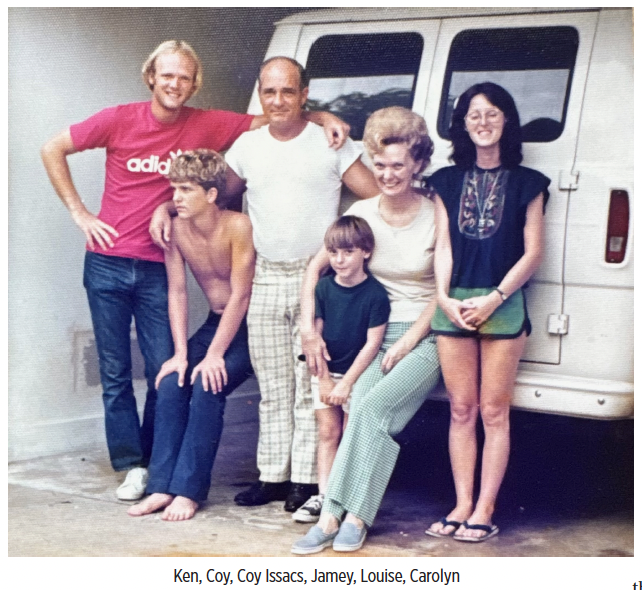
“When I was just two years old, my biological father abandoned my mother and me. For the next 4 years, she raised me as a single mom. When I was six, she married a man named Coy Isaacs. At ten years old, Coy adopted me, and my last name was legally changed from Warren to Isaacs. That Father’s Day in 1962, as a gift to him, I began calling Coy “Daddy.” From that year on, I considered him my father.
I soon came to the conclusion that my parents liked to move. In my twelve years of education, I went to 13 schools in seven cities in four states throughout the Southeast. So I was always “the new kid.” One day when I was in third grade, I looked outside to see our 1956 Chevrolet loaded with my bed strapped to the top. We drove all day into the night to the new town my parents had chosen. Around the time I might be able to start settling in, we’d leave for the next stop. The longest time I spent in one place was my last two years in high school in Boone, North Carolina, where I graduated.
Sadly, my daddy, Coy, died in 1979 of a massive heart attack when I was twenty-seven. In 2002, after deciding to try to find my biological father, I was able to locate him. After just one visit, I was grateful that he left Mom and me all those years ago. We were clearly better off and so blessed that Coy had come into our lives.
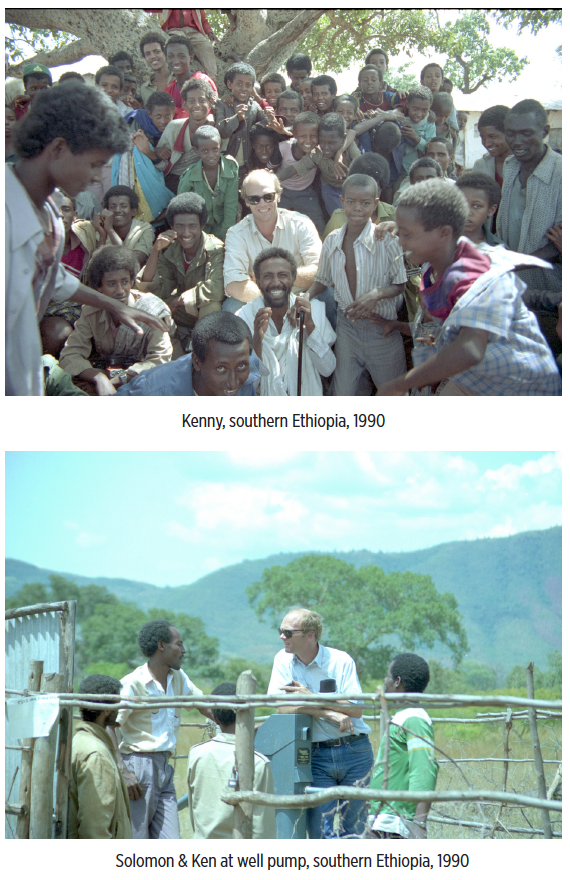

NOW LET’S RETURN TO KENNY’S TESTIMONY OF HOW HE CAME BACK TO CHRIST AND ENDED UP WORKING AT SAMARITAN’S PURSE:
KEN: By the time my wife and I were probably in our late 20s, early 30s, things of a spiritual nature started coming back up. And then at 34 we rededicated our lives to Christ. As a result of that and going to church, I got involved with the North Carolina Baptist men and went with them as a volunteer to West Africa for a month.
When I came back from that trip, I felt God was calling me to the world. And I couldn’t even explain that. I mean, I’m from this area. My wife was born and raised here, and when I came home and told Carolyn, I feel called the world, she looked at me and said, “have you lost your mind?”
That discussion went on for a while. I prayed about it. “You know, God, if you’ve got something for me, if you open the door, I’ll go through it.” And I prayed that prayer for 16 or 17 months, and nothing happened. I stopped praying that prayer because I thought no answer meant NO.
Then in 1986 Dewey Wright Well and Pump Company drilled a well at Franklin Graham’s house and I took the opportunity to leave him my business card and said, “if something comes up about water in Africa, and I could help you, let me know.”
It wasn’t long until around August of 1987 he had someone reach out to me and asked me to come and talk to him. After that talk my family and I moved to Ethiopia. We lived there for three years and set up a clean water well drilling program in Ethiopia. There were two wars going on there. It was a very rich learning environment.
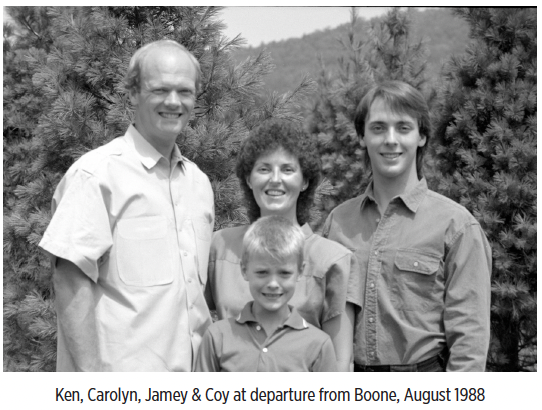
BEN: I knew you went to Africa with SP, but didn’t know you lived in Ethiopia. So, you took the whole family?
KEN: Yeah, the whole family. Our oldest son was 16 and getting ready to go into senior year of high school. He wasn’t happy about moving to Ethiopia at first, but it ended up working out well for him because he went to the international community school there in Addis, Ababa. It was there he found out that he was gifted in linguistics, so today he speaks four languages. From there, he spent 17 and a half years in the Marines and went to Naval Postgraduate School. Now he’s in Texas and working for Amazon.
Our younger son was eight, and it was an adventure for him to go see the elephants or whatever. I could go on about him too, but the point is it changed the nature of our family totally and strengthened us in the Lord. Being in Ethiopia expanded our worldview, and it put our lives on a much different course.
BEN: So, you transition from digging wells to living in Ethiopia for three years to directing major relief operations around the world since 1990?
KEN: That’s right, and I would return to Ethiopia in 1991 when the communist government was overthrown. Therefore, my own experience as a missionary to Ethiopia came in handy when war broke out. Here’s what happened:
As a result of the war that overthrew the ruling Communist government, there were about 60 or 70,000 displaced refugees that came into Addis Ababa trying to escape the conflict. About 60,000 of them moved into an open roof football stadium and within that population were quite a few pregnant women, ready to give birth. So, we decided to take them to a greenhouse we had been to where we put some mattresses down, got some medical staff and birth attendants in, and we brought the pregnant women in where they could have a clean, dignified place to have birth.
Our mission at SP is to go to the ditches of life and look for people and help them in Jesus’ name. And we want people to know that God loves them. We want to show them love and introduce them to Jesus. The mission is always the same: These women are going to have babies. We’re gonna do something. And so, we brought those ladies out of the stadium, and we probably ran that program for two months.
During that same year, the first Gulf war was launched in May of 1991. Saddam Hussein attacked the Kurds who primarily live in a mountainous region called Kurdistan. Editor’s note: (Kurdistan spans across parts of Eastern Turkey, Northern Syria, Northern Iraq and Western Iran. It also has smaller communities in Armenia and Azerbaijan.)
About that time, I came back to Boone and Franklin Graham asked me to go to Turkey. I went there with a couple other guys, and we worked our way down to Iraq. It was there that the US Ambassador to Iraq gave us a helicopter to use. I was flying in and out of Iraq, seeing the Kurds and sitting down in the refugee camps and figuring out what was going on and what we could do to help.
After that I was on to Afghanistan and Somalia, then working around hurricane disasters, other wars, in Rwanda and Bosnia. Rwanda was a genocide. It was horrible. There were probably about a million people killed in just a few days.
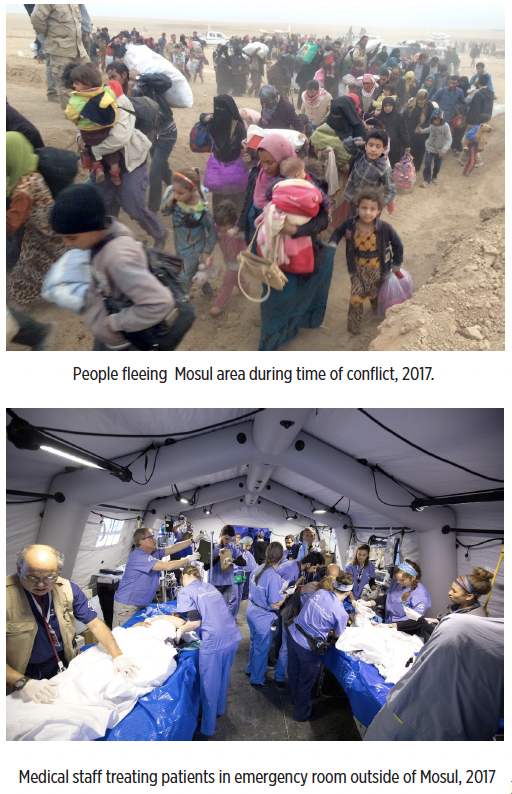

BEN: When I read your biography from your new book, I found it interesting that you were awarded a Lifetime Achievement Award from Health Outreach to the Middle East (H.O.M.E). The award was for his efforts to gain access that allowed for the deployment of the Emergency Field Hospital to Mosul, Iraq as Iraq security forces fought to regain control of the city. That must have been incredibly intense.
KEN: Well, it was intense. And I think God gave us great favor. ISIS was moving all through northern Iraq and up in Syria. There was so much violence, and I went over there on a trip to meet with staff and with the doctors as well.
They were doing mobile medical clinics, and they were telling us that more needed to be done.
When I got there, I had coffee with a lady and her assistant and our country director over there. I hadn’t seen her in some years. She worked with the UN and asked me, “So what’s going on in the world of Samaritans Purse?” I said, oh, you know, working and developing mobile field hospitals. So, she wrote down a guy’s name in the World Health Organization and said, you need to call him. So, I called and went and visited him the next day, and the World Health Organization was looking for a hospital, but a hospital is not a box of stuff, it’s a team of people, and you gotta have the doctors, anesthesiologists and nurses and all those things. And we had that.
So anyway, we ended up putting a hospital down about 10 kilometers east of Mosul. We had a fantastic group of people staffing that hospital, and we stayed there for nine months. We performed 1,700 life saving surgeries and had over 4,000 patients, and some of those patients were ISIS fighters. As long as I live in this world, I will always wonder how those patients got to us alive. Because there was so much killing and the survival rate was about zero.
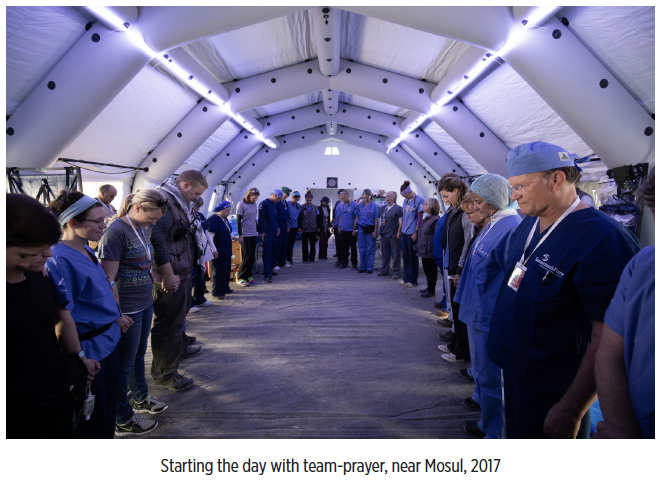
BEN: It’s amazing that ISIS itself didn’t try to destroy the field hospital.
KEN: Well, you know, we had a Lebanese interpreter that didn’t look Arabic, who spoke fluent Arabic, and he was doing some attendant stuff in the men’s ward. And one of the chief fighters, you could tell he was by the way he dressed, the length of his pants, his beard and everything. He asked why are these people being so kind to us? We’re trying to kill them. And, you know, and I think that was an encouragement to all of us to continue to show the love of Christ, even to somebody that you know is antagonistic towards you and your enemy. God blessed us and gave us great favor there, and he used us in a mighty way.
BEN: Wow! In one of our previous Journey Magazine articles we shared Kayleen Lundstrom’s testimony which included serving at that hospital as a nurse and it blew me away.
When I think of the risks that so many of you take to help in the midst of great crises it reminds me of that line in the song, “To Dream the Impossible Dream” that talks about being willing to march into hell for a heavenly cause.
Now let’s switch gears to talk about the chapter in your book that you titled:
“My Seventeen Month Detour Through Washington, DC.”
In that capacity, you served as Director of the Office of Foreign Disaster Assistance with the US Agency for International Development, USAID. And under your direction, you served as the lead agency for US government relief responses and to the 2004 Indian Ocean tsunami.
KEN: Yes, I left Samaritan’s Purse during George W Bush’s first administration. I was the Director of the Office for Disaster Assistance called OFDA.
And yeah, that tsunami in Indonesia happened on December the 26th of 2004 and killed about 230,000 people. It was a huge emergency response. The United States government sent ships there and the Department of Defense was heavily involved. There were probably 15,000 Americans involved in the response.
I didn’t have any illusions that I was going to tell the military what to do, but I did go meet with the head generals and offered to provide senior humanitarian advisors in every appropriate rank of their strategic decision making and they quickly and warmly accepted the offer. I had people sitting next to every general, next to all the admirals that were involved. We had them on aircraft carriers. We had them in airplanes and military bases. And it worked out well, It was a big deal, but I learned a lot. You know, you learn a lot through experiences,
BEN: That’s so true and we could help people learn a lot from our failures and mistakes as well.
That segues nicely to make some final comments about your new book that is filled with the lessons you’ve learned from your many adventures in some of the most dangerous situations around the world.
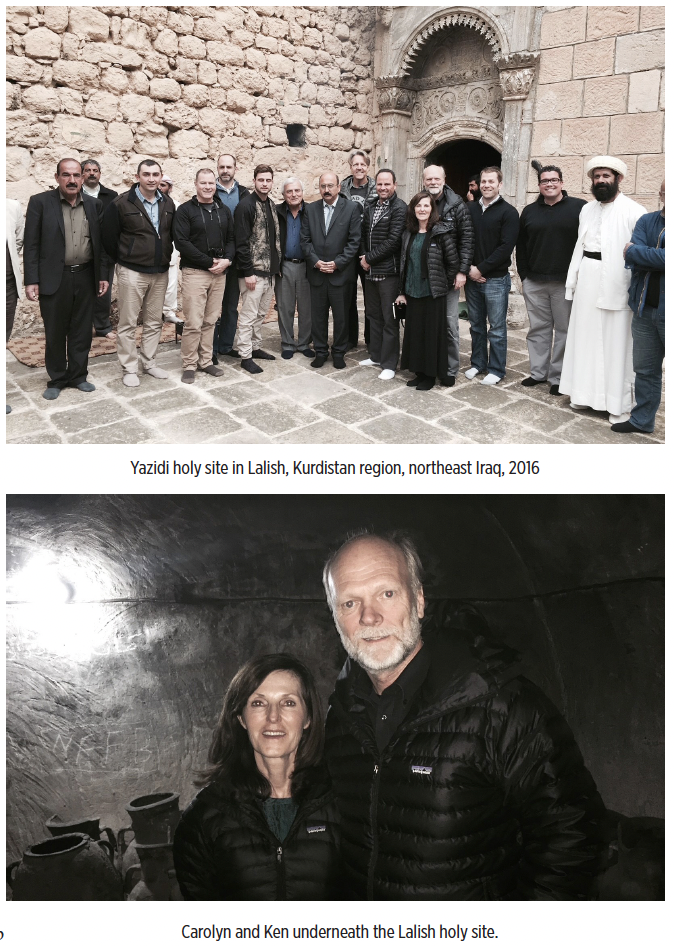

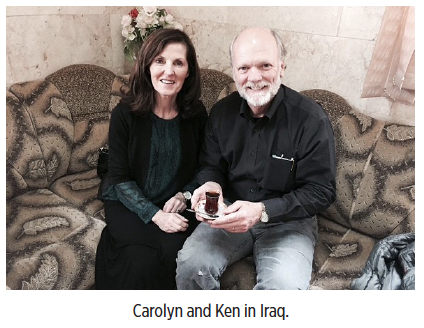
KEN: The book is titled “Running to the Fire: Helping in Jesus’ Name.” It is a memoir of sorts, not that I think I’m finished, but it’s a memoir of things that I’ve seen in my over 37 years with Samaritan’s Purse. It’s a collection of some of the stories that you asked me about and how I got involved. From a well driller to the rest of the world. In the book I talk about my wife who died in 2017. She passed away from cancer. We were married 46 and a half years.
BEN: And you were probably the primary caregiver.
KEN: Yeh I was able to stay home and take care of her and work at the same time using the telephone, and people would come up to the house. I will be forever grateful for that latitude I had.
BEN: She was a great woman in her own right because of the sacrifices she made with you in Ethiopia, moving to Washington DC when you worked there and being alone for long periods of time when you were traveling to places where you could easily have died.
KEN: That’s true. Sometimes I’d be gone for three months, six months, nine months. I would come home and then deal with whatever I had seen and been exposed to which she was not aware of. She never pushed me, except to say, hey, get up, let’s go for a run. Let’s go for a walk. She was a great exercise person.
BEN: I think the fact that she deployed with you at the very beginning of your marriage was probably the thing that helped her. She knew the intensity of it all.
KEN: That’s good. She was always there for me. And sometimes I couldn’t talk about things for weeks or months. There was a period of my life where all the things that I was seeing you know, Bosnia and the genocides and all of this, they take a toll on you.
BEN: You probably had some trauma, like PTSD, right?
KEN: Yeah, it’s traumatic, but my wife was the perfect shoe on this old foot to make me feel comfortable and get me talking about it.
And you know, when we were up in New York City after 9/11, we went through stress management training down by the harbor to get our credentials. If you remember, to get to Ground Zero, you had to go there.
You had to take that eight-hour training, and we were one hour into that training, and I looked over at Mickey Stoner and Skip Heitzig and I said, guys, I’ve got Post Traumatic Stress Disorder. I realized I’d been suffering with this for years, and I didn’t know what it was until that woman running the clinic, I think her name was Teresa, identified it in me.
I’ll never forget it. She explained to us what it was and what the symptoms were, and I’m listening to her, and I realized she’s describing me. I had been wrestling with those things for years, but the Lord carried me through all of that.
BEN: Here’s the million dollar question I didn’t ask at the beginning. And I know you shouldn’t do this, but it’s okay for men to do it. How old are you?
KEN: I will be 73 tomorrow.
BEN: Well, happy birthday. And tomorrow, you’re going to Israel? Is that right?
KEN: I’m going to Israel. I’m going to Gaza on my birthday.
BEN: I’m sure that’s a very intense situation to walk into.
KEN: It is, I’ve spent about four months in Israel, and it’s intense. Also I spent about a year in Ukraine.
The world is a dicey place with a lot of things going on, and Samaritan’s Purse wants to be there. It’s not that we’re chasing adrenaline. We don’t do it because it’s fun. We know because we’re called to do it, but we literally run to the fire, and that’s what my book is about, running to the fire, helping in Jesus’ name.
BEN: And it seems like ever since you and I were together in New York City after 9/11, the world is getting darker.
KEN: You know, I look at the world today with the electronic communications, artificial intelligence, the wars, the famines, the storms, the floods, and I think of Matthew 24. I think it’s going to get worse. The speed seems to be picking up on the fulfillment of those verses. I’m not a theologian or a student of prophecy, but I read my Bible, and I can’t help but notice those things.
BEN: Yeah, I think the sad thing about many Christians in our American culture today is that they depend on others to tell them what the Bible says instead of devoting time to immerse themselves in the reading of God’s Word for themselves.
KEN: I would advise everybody to read the Bible. God’s word is straightforward, and there’s no denying things that are going on in the world today and that those things are written about in the Bible.
BEN: Well, thanks so much for taking the time with us today. We’ll be praying for you.